


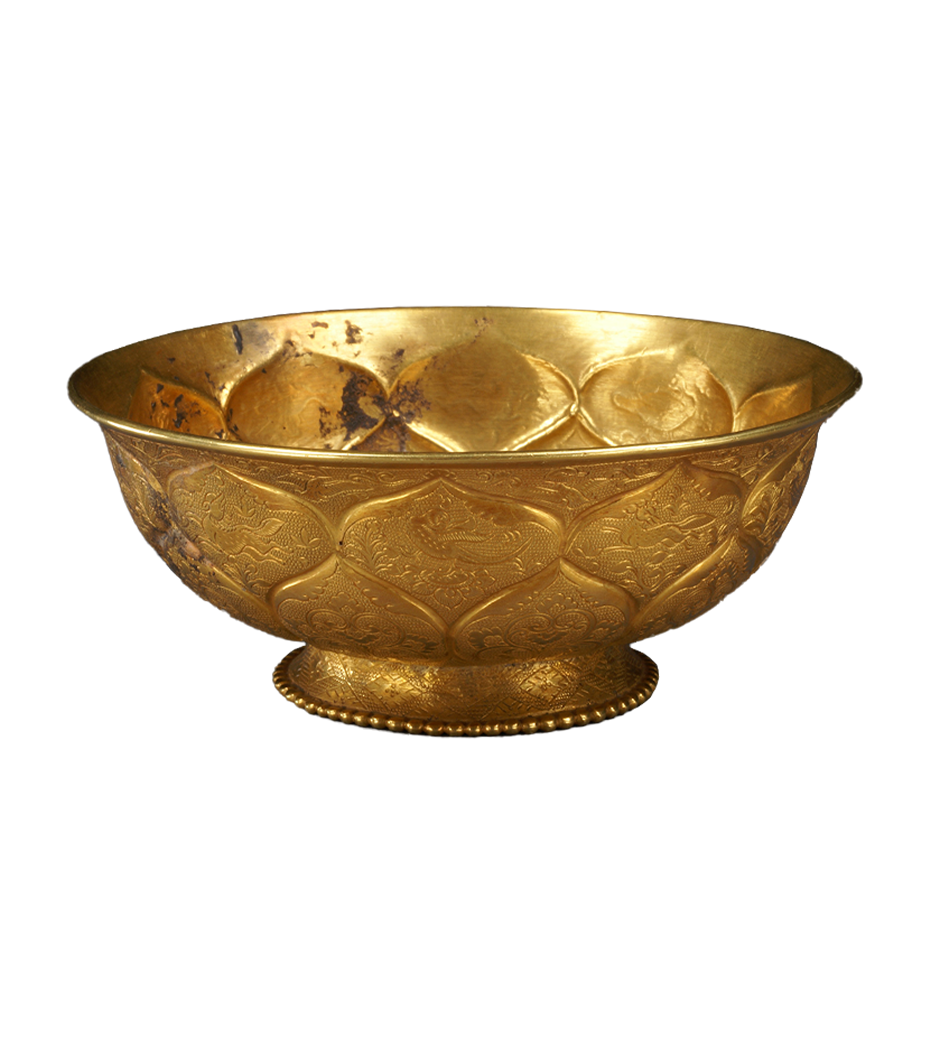
Gold Bowls with Mandarin Ducks and Lotus Petals


Large image
These two gold bowls are the epitome of the innovative integration of Chinese and Central Asian cultures during the Tang Dynasty. They are renowned for their elegant shape and exquisite workmanship. The two layers of lotus-petal patterns with images of animals and plants on the body are remarkable, incorporating the typical Chinese aesthetic pursuit of a harmonious co-existence of man and nature into the high-precision repoussé technique which was well developed in Sogdian silverware manufacturing from the 5th to 6th century CE. Both bowls are identical in shape and decorations, made of pure gold, with the ink characters “Jiu Liang Ban” and “Jiu Liang San” on the inner walls respectively, indicating their weights and reflecting the standardization of gold and silverware production. Determined from the other cultural relics unearthed at the same time and historical records, the gold bowls were used as wine vessels on important occasions like banquets and ceremonies of the upper-class society in the Tang Dynasty.
Era:
Tang Dynasty (618-907)
Provenance:
Hejiacun Hoard in the Southern Suburb of Xi’an in 1970
Size:
Object 1: Height 5.5cm; Mouth Diameter 13.7cm; Ring Foot Diameter 6.8cm; Weight 392g Object 2: Height 5.6cm; Mouth Diameter 13.5cm; Ring Foot Diameter 6.8cm; Weight 391g
top